
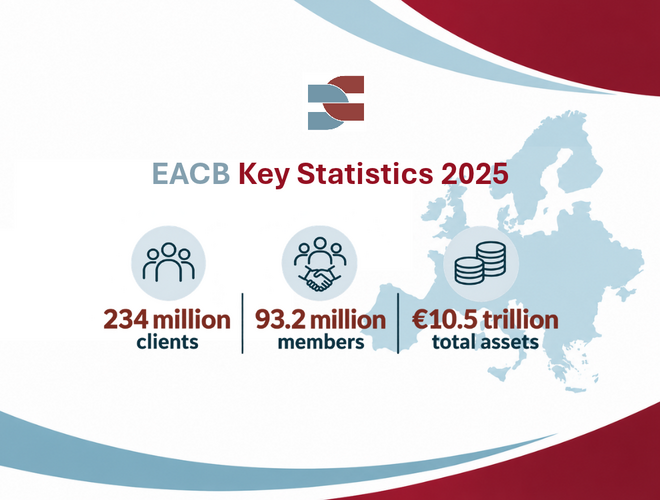
The European Association of Co-operative Banks (EACB) has published its annual Key Statistics, showing that European cooperative banks serve approximately 234 million clients, 93.2 million members and hold €10.5 trillion in total assets.
The publication is accompanied by a research letter by Prof. Hans Groeneveld of Tilburg University, providing a comparative assessment of the performance and distinctive characteristics of 18 European cooperative banking groups and their banking competitors.
Key highlights from the research
- Financing the real economy: Loans represent 54% of cooperative banks' total assets, compared with 38% for other banks, reflecting their strong focus on lending to households and businesses.
- Growing membership: Cooperative banks welcomed half a million new members in 2025, with the member-to-population ratio reaching a record 21.6%.
- Deposit growth: Deposits increased by 3.5% in 2025, outpacing the 2.4% growth recorded by other banks and continuing a longer-term trend.
- Positive employment trends: Employment increased by 1% at cooperative banks, compared with a 1% decrease at other banks.
- Financial strength: The average Tier 1 capital ratio reached a new record of 19.6% in 2025.
Priscille Szeradzki, President of the EACB, commented:
"With 234 million clients, over 93 million members and €10.5 trillion in assets, cooperative banks demonstrate the strength and significance of their model in Europe's banking landscape. Deeply rooted in Europe's economic and social fabric, they are essential partners in financing households, businesses and communities. As Europe seeks to strengthen its competitiveness, resilience and economic sovereignty, cooperative banks have a vital role to play in mobilising investment and supporting sustainable growth across its regions."
Nina Schindler, Chief Executive Officer of the EACB, added:
"The latest research highlights the distinctive strengths of cooperative banks, particularly their anchor role in financing the real economy and their critical contribution to financial resilience. These findings demonstrate the value of a diverse banking landscape, where different business models respond to the needs of European citizens and businesses. It is imperative that Europe ensures that its regulatory framework recognises and safeguards this diversity of its banking landscape. Addressing red tape, reducing complexity, and improving policy design to allow all types of European banks to finance growth are the key EACB demands across our contributions to the debate on the EU's simplification agenda."
Explore the publications
Download the EACB Key Statistics 2025
Download the Research Letter – European Co-operative Banks in 2025: A Concise Assessment