
Message from the CEO, Nina Schindler
As we release this edition of the EACB newsletter, we do so with a strong sense of momentum and responsibility. Europe is entering a phase where clarity, coherence and competitiveness are not abstract policy goals: in volatile macro conditions these are pre-requisites that will determine our capacity to invest, to innovate, and to support the communities we serve.
Cooperative banks feel this reality first‑hand: when the framework is stable and proportionate, our institutions can channel their full energy into long‑term financing and partnership with households, farmers and SMEs across the Union.
This edition brings together reflections from our President and insights from the European Commission’s DG FISMA at a moment when simplification and market integration are moving from aspiration to concrete action. Their perspectives remind us that meaningful progress happens when ambition meets pragmatism, and when all actors work towards a common horizon.
In 2026, the EACB will continue to bring the voice of cooperative banks to the centre of these debates, constructively, confidently, and with the long‑term well‑being of Europe’s people and regions always in view.
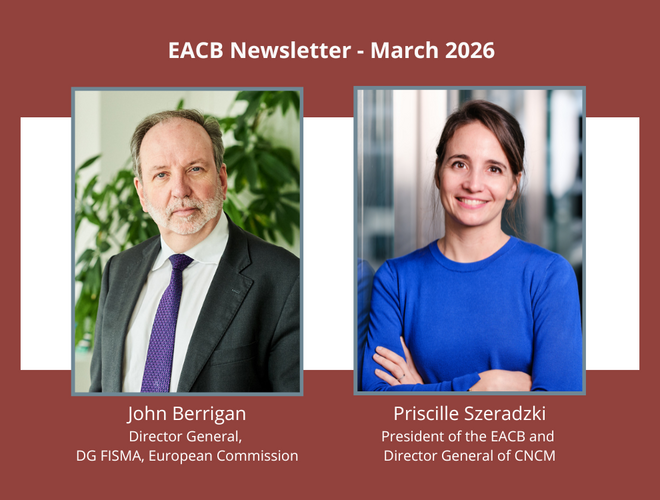
2 Questions to John Berrigan, Director-General of the Directorate-General for Financial Stability, Financial Services and Capital Markets Union (DG FISMA) of the European Commission
John Berrigan is the Director-General of the Directorate-General for Financial Stability, Financial Services and Capital Markets Union (DG FISMA) of the European Commission.
DG FISMA is responsible for EU-level policy-making and legislative initiatives with respect to the financial sector, including Banking Union, Capital Markets Union, sustainable finance, digital finance, anti-money laundering and sanctions. In this context, John represents the European Commission on the Economic and Financial Committee and the Financial Services Committee, which report to EU Finance Ministers. He also represents the Commission on the Financial Stability Board, which reports to G20 Finance Ministers. He attends the European Systemic Risk Board and is a permanent observer on the Single Resolution Board.
_____________________
The Commission’s 2025 work on the simplification agenda (including progress under the Omnibus initiatives) has created momentum for a more efficient and innovation friendly regulatory framework. In consideration of the recently joint legislative priorities, and the Commission 2026 work programme, in which ways the next wave of simplification shall directly contribute to Europe’s competitiveness, and give financial institutions the clarity and agility they need to support investment across the Union?
The Commission’s simplification agenda is a central pillar of Europe’s broader competitiveness strategy. In financial services, we have already delivered meaningful progress through targeted initiatives, including the Omnibus package on sustainability reporting the Level 2 measures de-prioritisation exercise, and improved data sharing rules. In addition, in June 2025 the Commission put forward a proposal to make the EU securitisation framework simpler and more fit for purpose, facilitating securitisation activities in the EU, allowing greater agility in banks’ balance sheet management, while preserving financial stability. Taken together, these measures aim to reduce unnecessary burden, enhance proportionality and provide greater regulatory clarity.
However, simplification is not only about tweaking rules. Real simplification also comes from market integration – making progress on the Savings and Investments Union is therefore key. Financial market participants need a framework that enables them to operate seamlessly across borders, compete effectively, and scale up throughout the Union. With respect to capital markets regulation, the recent Market Integration Package seeks to eliminate barriers to integration in trading, post-trading and asset management. On 11 February the Commission moreover launched a consultation on the competitiveness of the EU banking sector to seek stakeholders’ input on how to streamline unduly complex and ineffective rules as well as on how to remove barriers that unduly restrict the possibility for EU banks to operate cross-border. Our objective is clear: a more efficient, coherent and innovation-friendly regulatory framework, preserving financial stability, market integrity and investor protection. By reducing complexity and eliminating undue burden, but above all by deepening the market integration, financial market participants will be equipped with a clearer and more agile regulatory and supervisory framework that will allow them to better use the opportunities of the single market and scale up their activities across Europe. This will help them mobilise savings, boost investments, strengthen Europe’s global competitiveness.
As the EU pursues both simplification and enhanced competitiveness, a holistic view of regulatory impact and coherent implementation become essential. How will the Commission ensure that upcoming simplification measures — from Omnibus packages to the expected exercise on the banking sector competitiveness — contribute to a more predictable environment that strengthens Europe’s financial ecosystem and its ability to channel finance into strategic priorities?
A key challenge is to successfully reconcile two legitimate but sometimes conflicting stakeholders’ expectations: on the one hand, the many calls to simplify, adjust and recalibrate the framework that could entail a fundamental revision of the rules; and, on the other hand, the need for transparency, predictability and stability. Finding the right balance is key to design a credible regulatory and supervisory framework. Close coordination with the European Supervisory Authorities and continuous stakeholder engagement can help improve the clarity and proportionality instead of generating uncertainties and frictions as well as disruptions.
A second principle is that simplification is not deregulation. Reduction of unnecessary burdens should not come at the cost of undermining financial stability, market integrity and investor protection. The EU’s financial framework must remain robust, aligned with internationally-agreed principles and capable of withstanding future shocks. That principle – strong but fit-for-purpose and internationally aligned regulation – drives our holistic screening of the financial acquis, balancing costs and benefits.
Finally, a key consideration is that delivering simplification is a shared responsibility between the Commission, co-legislators, Member States and competent authorities. For our efforts to be successful, all actors must share the same overall objective and move in the same direction. For instance, achieving genuine simplification at EU level must also be supported by a timely and effective implementation in each Member State, thereby mitigating undue fragmentation and unnecessary gold-plating. Only then, will we be able to collectively create a modern, predictable and innovation-friendly regulatory environment for EU financial market participants. And, if we succeed, this will in turn transform and strengthen Europe’s financial ecosystem and enhance its capacity to channel finance towards strategic priorities, including sustainable investment, innovation and digital transformation.
Second Opinion from Priscille Szeradzki, President of the EACB & Director-General of the Confédération Nationale du Crédit Mutuel
Priscille Szeradzki currently serves as Director General of Confédération Nationale du Crédit Mutuel (CNCM), the central body of Crédit Mutuel group. Before joining the group, she worked in the field of international relations, for the French agency in charge of granting asylum, and as a diplomat for the Ministry of Foreign Affairs. She then joined the Ministry of Economy and Finance, where she led significant projects and negotiations at the international, European, and national levels.
_____________________
Competitiveness requires a strategic reassessment of the regulatory framework. If Europe wants finance to power investment, we must lighten the load where rules add weight and smooth the path where markets face friction. In a complex geopolitical environment, Europe’s competitiveness will increasingly depends on its ability to finance strategic autonomy, resilience and long-term investment at scale.
From a cooperative banking perspective, the Commission’s simplification drive, concretised in 2025 through the Omnibus initiatives, is the right move at the right time. It reflects what our members experience daily across towns, regions and rural communities: when regulation is clear, proportionate and predictable, banks can spend less time interpreting complexity and more time financing the real economy — supporting SMEs, households and local projects. In this context, we welcome DG FISMA’s targeted consultation on the competitiveness of the EU banking sector. Cooperative banks see several aspects of prime importance.
First, clarity frees capacity. A streamlined rulebook, built on practical implementation and stable timelines, enables banks to focus resources on customers and investment. Proportional reporting, fit-for-purpose prudential supervision and coherent capital markets rules are essential. Simplification must deliver tangible relief by eliminating duplication, aligning overlapping requirements and focusing reporting obligations across EU frameworks. Predictability itself is a key driver of competitiveness. Greater coordination across regulatory silos and policy areas is equally important. This is evident in ESG reporting, but also in digital identity, cybersecurity, artificial intelligence and the data economy, where alignment with financial legislation remains incomplete. Likewise, combating financial fraud requires a broader ecosystem approach, as its origins often extend beyond the banking sector itself..
Second, protecting the diversity provided by cooperative banks. Europe’s strength lies in its plural banking ecosystem. Cooperative banks channel member savings into productive investment because they are locally rooted, member-owned and focused on long-term relationships. Simplification must therefore embed proportionality in both legislation and supervision, ensuring that cooperative banks’ specific governance structures and business models are fully recognised. Where EU rules are simplified, implementation should follow suit without national gold-plating, so that simplification translates into real-world effectiveness.
Third, integration unclogs Europe’s funding pipelines. Simplification is powerful, but market integration multiplies its impact. Progress toward a genuine Savings and Investments Union will help convert Europe’s substantial savings into financing for the green transition, digitalisation and industrial renewal. Cooperative banks play a key role at the intersection of household savings and SME investment. Simplifying capital requirements, reducing cross-border friction in capital and liquidity management, streamlining market rules and ensuring supervision that remains aligned with underlying risks will allow funding to flow more efficiently across the Union.
At the same time, prioritisation is urgently needed in retail banking and technology. The cumulative demands of initiatives such as the digital euro, instant payments, open finance, DORA, cybersecurity and artificial intelligence are placing significant pressure on banks’ innovation capacity. To ensure innovation is not consumed by compliance, policymakers must focus on what is essential, promote reuse of existing solutions and maintain lean reporting frameworks.
Across all these areas, coherence and stability in implementation are essential. Close coordination between legislators and supervisors, combined with a steady, consultative approach, will give banks the certainty needed to plan and invest with confidence over the long term.
Cooperative banks stand ready to translate simplification into investment. With clear, stable and proportionate rules, and more integrated markets, we will continue to mobilise local savings, finance local ambition and strengthen European competitiveness. Simpler, smarter rules and deeper, more connected markets will make Europe not only safer but also better equipped to finance its future in a fair and sustainable way.