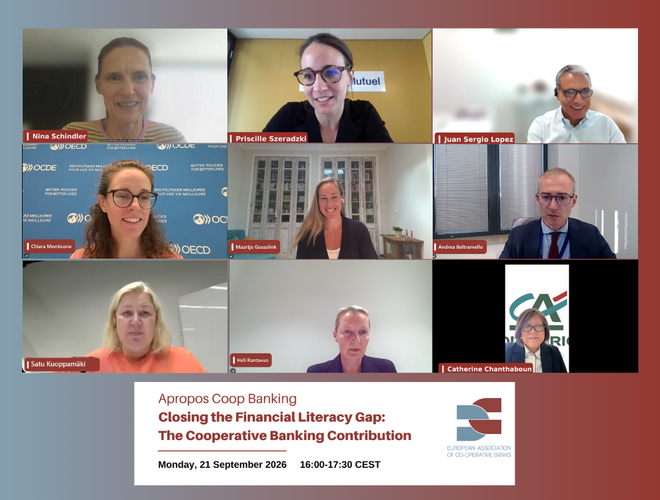
Brussels, 21 September 2026 – The European Association of Co-operative Banks (EACB) brought together the cooperative banking sector, the OECD and the European Commission for its latest event, “Closing the Financial Literacy Gap: The Cooperative Banking Contribution”. The webinar featured Andrea Beltramello, Head of Unit at the European Commission’s DG FISMA, and Chiara Monticone, Senior Policy Analyst at the OECD, alongside representatives from cooperative banks.
The discussion, held as part of the EACB’s Apropos Coop Banking series, explored the cooperative banking sector’s practical experience in financial education, international evidence and good practices, as well as the policy conditions needed to support effective initiatives. Particular attention was given to the EU Financial Literacy Strategy and the Commission’s forthcoming Code of Conduct for financial literacy initiatives.
Financial education has long been embedded in the cooperative banking model, reflecting its commitment to education, member engagement and strong local communities. Across Europe, cooperative banks put this commitment into practice through initiatives designed to reach different audiences and equip people with the knowledge and confidence to make informed financial decisions.
In her opening speech, Priscille Szeradzki, President of the EACB, declared:
“Financial education is not an optional activity for cooperative banks; it is part of who we are. Our model has always been about empowering people to take greater control of their economic lives. As Europe steps up its efforts to strengthen financial literacy, cooperative banks stand ready to contribute their experience, local presence and proven initiatives to this shared objective.”
Drawing on the OECD’s longstanding work on financial literacy, Chiara Monticone, Senior Policy Analyst at the OECD, shared insights on the role of different stakeholders in delivering effective financial education initiatives. She commented:
“Today’s discussion provided a valuable opportunity to exchange perspectives on how different stakeholders can contribute to strengthening financial literacy. The financial sector, including cooperative banks, have an important role to play alongside public and not-for-profit actors. As the OECD/INFE works to revise its Guidelines for Private and Not-for-profit Stakeholders in Financial Education, exchanges such as this help bring together practical experience and the broader policy discussion on delivering high-quality financial education.”
The discussion was grounded in practical examples from across the cooperative banking sector, with contributions from Catherine Chanthaboun, Fédération Nationale du Crédit Agricole; Maartje Gosselink, Rabobank; and Satu Kuoppamäki and Heli Rantavuo, OP Pohjola, showcasing different approaches to strengthening financial literacy and reaching diverse audiences.
The subsequent panel exchange of these experts with Andrea Beltramello, Head of Unit at the European Commission’s DG FISMA, explored the Commission’s priorities and the conditions for strengthening financial literacy in Europe, including public-private collaboration and how the EU framework can build on effective initiatives already in place. He emphasised:
‘’Financial literacy is a cornerstone of the EU’s Savings and Investments Union Strategy. Empowering citizens with the knowledge to make informed decisions – from day-to-day household budgeting to long-term investing – is essential for building true financial resilience and wellbeing. Under our EU Financial Literacy Strategy, we want to ensure every European feels confident navigating the financial system. Trusted partners are indispensable in this effort, bringing education and community engagement directly to citizens at the local level.’’
Reflecting on the discussion, Nina Schindler, CEO of the EACB, concluded:
“Financial literacy is a shared objective that requires ongoing dialogue and collaboration. Cooperative banks bring longstanding expertise and a wealth of practical initiatives to this effort, and the EACB will continue to engage with the European Commission and other public bodies to ensure that its members’ extensive experience and resources contribute meaningfully to the broader European financial literacy agenda.”
EACB Contact:
CEO: Nina Schindler
Nina.Schindler@eacb.coop
Lead Communication: Luce Jacqmin
Luce.jacqmin@eacb.coop
About the EACB:
The European Association of Co-operative Banks (EACB) is the voice of the cooperative banks in Europe. It represents, promotes and defends the common interests of its 26 member institutions and of cooperative banks in general. Cooperative banks form decentralised networks which are subject to banking as well as cooperative legislation. Democracy, transparency and proximity are the three key characteristics of the cooperative banks’ business model. With 2,400 locally operating banks and 36,200 outlets cooperative banks are widely represented throughout the enlarged European Union, playing a major role in the financial and economic system. They have a long tradition in serving 228 million customers, mainly consumers, retailers and communities. Cooperative banks in Europe represent 91 million members and 720,000 employees and have a total average market share of about 20%. Website: www.eacb.coop | Follow us on Linkedin