
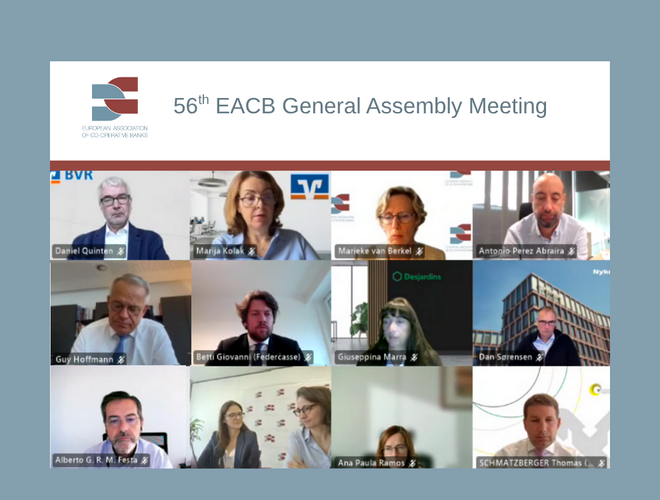
Brussels, 30 September 2025 - The European Association of Co-operative Banks (EACB) successfully held its 56th General Assembly Meeting online, bringing together senior executives, board members and representatives from the cooperative banks and mutual lenders across Europe and overseas to address new policy initiatives shaping the financial services landscape.
One such initiative was the European Savings and Investment Account (SIA), a key element announced as part of efforts to deepen the EU’s Savings and Investments Union (SIU). This initiative was deemed particularly relevant for cooperative banks which, thanks to their close client relationships and strong local presence, are well placed to help boost retail participation in capital markets and could play a key role as SIA distributors. At the same time, the discussion underlined the need to carefully manage the SIA’s interaction with the Retail Investment Strategy to avoid unnecessary compliance burdens and to clarify its distinction from the planned Finance Europe long-term investment label.
The ongoing debate on the simplification of the prudential framework also featured prominently. EACB members had the honour of exploring the topic in depth with Isabelle Vaillant, Director of Prudential Regulation and Supervisory Policy at the European Banking Authority, exchanging views on approaches to reducing regulatory complexity. Such an approach, members recalled, should aim to reduce unnecessary burdens and enhance consistency while safeguarding financial stability - including by pausing non-essential new rules, ensuring supervisory bodies remain within legal mandates, streamlining overlapping and complex requirements and ensuring coherence and more effective solutions for reporting and disclosure across frameworks.
Reflecting on the meeting, Priscille Szeradzki, EACB President stated: “In a complex geopolitical environment, the cooperative banking model continues to prove its relevance, supporting communities globally and fostering a resilient, inclusive financial system. To achieve this, the regulatory framework must be holistically assessed, simplified and streamlined, reducing unnecessary burdens while maintaining strong safeguards and avoiding surface-level reforms. We strongly believe that meaningful simplification will allow Europe to pursue its competitiveness objectives.”
Nina Schindler, EACB CEO, concluded: “As we work toward simplification, it is essential to maintain open dialogue with regulators and supervisors. Exchanges like this help translate abstract aims into concrete measures—measures that have a tangible impact on banks of all sizes, their members and their clients, while unlocking Europe’s investment capacity."